
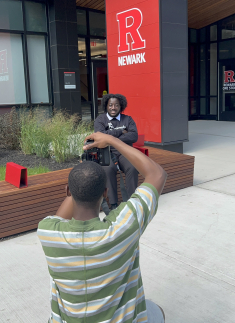
“I wanted to make my business official but didn’t know where to start.”
Moutar Sampil, a current Rutgers-Newark marketing sophomore, owns a photography business named Samproma which offers services to college students and event organizers in New Jersey and New York City. “While I was confident in my photography and editing skills, I realized I needed guidance on the business side to take Samproma to the next level. I wanted to establish my LLC, create proper client contracts, and develop the structure needed to operate professionally and build long-term credibility.”
The Rutgers Community and Transactional Lawyering Clinic (CTLC), in collaboration with the Rutgers Advanced Institute for the Study of Entrepreneurship and Development (RAISED) at Rutgers Business School, has been hosting a series of Limited Liability Company (LLC) Formation Workshops. This innovative clinic is designed to empower New Jersey’s small business owners by helping them establish LLCs—an essential step in protecting personal assets and unlocking key legal and financial benefits.
The workshop is a limited engagement clinic that offers free legal counseling provided by the CTLC's clinical students, who have designed and now run the program entirely. RAISED complements this effort by funding the licensing fees required to officially form the LLCs, removing a critical barrier for many aspiring entrepreneurs.

“As a relatively new entrepreneur, I did not know how to apply for or begin the process for obtaining a Certificate of Formation, LLC,” said Martin Rogers, an alumnus and owner of Nice Ride Auto Sales (NRAS), an auto sales and repair business in New Jersey “Also, I was not aware of certain property barriers, such as zoning ordinances, space, and other property-related matters otherwise required to obtain a dealership license nor did I know about the small business organizations available to help entrepreneurs with start-up business grants/loans.”
Since its inception, the clinic has successfully assisted nearly 10 local entrepreneurs, including Sampil and Rogers, in forming LLCs. Participants receive hands-on guidance through the legal formation process, ensuring their businesses are structured for long-term success and liability protection.
“The clinic and law students have been a tremendous help to me by providing a comprehensive approach in the formation of my business as well as next steps to improve and grow my business through small-business programs and legal support system,” said Rogers.
RAISED, a research institute housed within Rutgers Business School, brings together research, teaching, and community engagement to support entrepreneurship across New Jersey. Its partnership with Rutgers Law exemplifies the university’s commitment to interdisciplinary collaboration and community service.
“The Transactional Law Clinic is a vital initiative for RAISED because it ensures that our budding entrepreneurs, students and formerly incarcerated individuals, receive the legal guidance they need,” said Jasmine Cordero-West, RAISED Associate Director. “From forming an LLC to understanding compliance, having expert advice early on helps entrepreneurs avoid costly mistakes and build a strong foundation for growth.”
The LLC Formation Workshop not only provides vital support to local business owners but also offers Rutgers students a unique opportunity to apply their legal and business education in a real-world setting. As the clinic enters its third iteration, it continues to serve as a model for how academic institutions can foster economic development and entrepreneurial growth in their communities.

CTLC Co-Director Tomica Burke Saul says there are numerous benefits to clinic students, including one-on-one, limited engagement counseling. “They have to answer on-the-spot legal questions that are tailored to the participant's business needs,” she said. “The advanced students who organize the clinic are tasked with all of the logistics and planning with our community partner, so they learn how to engage with and be accountable to organizational clients. They also develop public speaking and presentation skills as they direct the clinic in real time.”
Professor Saul adds that the clinic continues the mission of Community Economic Development by supporting nonprofit clients, underrepresented entrepreneurs, and mission-aligned community groups. “Through a mix of direct client representation and organizational clients, students are exposed to a wide range of practice areas including nonprofit and corporate governance, regulatory, employment, intellectual property and general corporate transactional work,” she said. “In addition to building this core set of transactional legal skills, students also develop projects with organizational clients to serve a wider swath of community members. In these projects, students are responsible for organizing webinars, in-person information sessions, pop-up clinics, such as our contract review pop-up, and LLC pop-up clinics.”
Sampil said, “The opportunities [provided by Rutgers] feel endless, and I genuinely believe no other university could have offered me the same level of empowerment and belief in my potential.”
One of the goals of the Rutgers Law Strategic Plan is to deepen connections with our communities through our clinical programs. Our strategy is to strengthen relationships with community members and key constituencies to ensure that clinical offerings are informed by and responsive to community needs. Click here to learn more about our Strategic Plan.