
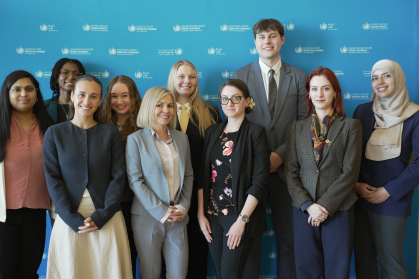
While most law students study international human rights law from a casebook, a group of Rutgers Law students experienced it firsthand. Through a special course offered by the Rutgers Center for Transnational Law, 10 students spent much of the spring 2026 semester preparing for a week embedded in the work of the United Nations Committee Against Torture (CAT) in Geneva, Switzerland. This access was made possible by the Center’s founding director, Professor Jorge Contesse, who has served as an independent expert on the Committee since 2024.
“I think the most exciting thing about bringing students is that we give them exposure… to how a very particular area of the law—international human rights law—is implemented in practice,” Contesse said, “by engaging with the Committee Against Torture, by looking at and understanding how UN mechanisms work and how civil society organizations operate in this UN ecosystem.”
During the week, students sat in on CAT's review of several nations’ compliance with the UN Convention Against Torture, watching committee members address each country’s delegation directly. They also met with CAT Chair Claude Heller of Mexico and Vice-Chairs Ana Racu of Moldova and Huawen Liu of China, along with several other Committee members, and heard from staff in the Office of the High Commissioner for Human Rights’ (OHCHR) Petitions Section about how individual complaints of torture reach the Committee and other UN treaty bodies.
For Ivana Genov ’27, the trip reframed what she thought she knew. “This experience has allowed me to see a different scope of what we have learned in the United States,” she said. “A lot of our coursework at Rutgers is more focused on domestic law and being able to see firsthand how these international events are coordinated—and hear from experts in the field who’ve spoken about diplomacy and the soft skills needed to be a good lawyer in the international context—has been so eye-opening.”

The trip’s roots stretched back to the classroom. Earlier in the semester, students were assigned a specific country under review of the Committee to conduct research in support of the review process, a model that Professor Contesse borrowed from his colleague Claudio Grossman, a prominent human rights scholar and former Chair of the Committee Against Torture. In Geneva, the students were able to watch their work come to fruition.
Between CAT sessions and visits to UN sites at Geneva’s Palais Wilson and Palais des Nations, students were afforded several opportunities throughout the week to explore the main sites the city of Geneva has to offer. The group took in the city's Old Town, the Jet d'Eau fountain on Lac Léman, and the flower clock in the Jardin Anglais. Some students also crossed into neighboring France, spending free time in the villages of Ferney-Voltaire and Annecy.

Laura Garcia ’26 says the week reframed how she thinks about the law. “Something that has inspired me from this trip was finally seeing in action the marriage of human rights and law,” she said. “It was something I didn’t have very clear when I first started law school.”
Kristen Gioioso ’26 put it simply: “This is a once-in-a-lifetime experience. You’re meeting people from all over the world, doing important, novel work that’s going to affect countries and affect victims of torture. It’s truly the most unique experience I’ve had at law school.”
This year's Practicum carried extra weight for Elaine Robbins ’26 who took this course as a student in spring 2025 and served this year as teaching assistant on the trip. “My favorite experience of this trip has been getting to see my peers experiencing it for the first time and seeing how engaged they’ve been with all of the work throughout the semester leading up to this trip,” Robbins said. “Seeing how they’ve gotten to engage and learn more about the process has been really rewarding for me.”
Shortly after this year’s trip, Robbins was selected for a competitive internship with OHCHR’s Petitions Section, becoming the first Rutgers Law student chosen for the position out of more than 600 applicants worldwide.
Professor Contesse sees that kind of outcome as central to what the Center for Transnational Law is meant to teach. “The project gives students a deeper understanding of what the law is in practice, not just in the United States, not just at the level of international law, but transnationally.” Reflecting on the goal of the trip, he added, “I hope students will learn—and certainly experience—how human rights law works in real life, at least in part. Being able to connect what they have learned in theory with the actual practice is, in my view, one of the most important experiences of the Geneva project.”
One of the goals of the Rutgers Law Strategic Plan is to deepen our connections with our communities through strategic partnerships. Our strategy is to cultivate partnerships that expand career opportunities for students and expand our global impact by broadening the scope of legal field studies and fostering collaborations with legal communities in other nations. Click here to learn more about our Strategic Plan.


