
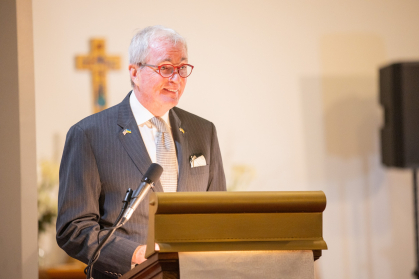
Four clients of the Rutgers Criminal and Youth Justice Clinic (CYJC) / New Jersey Innocence Project (NJIP) have been granted executive clemency by former New Jersey Governor Phil Murphy during his last days in office. The last two months brought long-sought and hard-won freedom to Stanley Holmes, Brenda Wiley, Robert Rose, and Abdul Haq-Salaam, who collectively had spent more than 135 years behind bars. Three of the four were serving life sentences, and two are factually innocent of the crimes for which they were convicted. More than 20 CYJC students at Rutgers Law in Newark worked with the clients over the last 13 years, as did former Clinic staff attorneys Elana Wilf and Tyler Dougherty and Professor Laura Cohen, CYJC director.

“The release of these four extraordinary people is a testament to their perseverance and the power of hope,” said Professor Cohen. “They, and we, are deeply grateful to Governor Murphy and his clemency team for giving them back their freedom.”
This brings the total to nine Rutgers Law clinic clients granted clemency by Governor Murphy since November 2025. Five men serving decades-long prison sentences received clemency with help from the Expungement Law Project at Rutgers Law in Camden.
Stanley Holmes
Just 25-years-old at the time of his arrest in 2002, Stanley Holmes, who had no prior criminal record, was working as a teacher's aide at a school for children with disabilities in the Bronx. He dreamed of one day becoming a teacher. Those dreams were dashed when he was wrongfully convicted of robbery and sentenced to 35 years in prison.
The Clinic's 12-year odyssey with Mr. Holmes began in 2013 when his federal habeas corpus petition was denied. A Holmes family friend reached out to Rutgers Law Professor George Thomas, one of the country’s leading criminal procedure experts, for assistance. Professor Thomas looped in Professor Cohen and the Clinic filed an amicus curiae brief in Mr. Holmes's appeal to the Third Circuit. After the appeal also was denied, the Clinic took Mr. Holmes on as a client and filed a successive petition for post-conviction relief, related appeals, and, most recently, the petition for executive clemency on his behalf. Governor Murphy commuted Mr. Holmes’s sentence to time served in late November. (Click here to watch the announcement) On December 4, he was greeted at the prison gate by a jubilant throng of family and lifelong friends, all of whom remained devoted to him and determined to secure his freedom throughout his more than two decades behind bars.
Brenda Wiley
CYJC staff attorney Tyler Dougherty ‘18 met Brenda Wiley in 2021 when Ms. Wiley agreed to share her story in an amicus curiae brief the Clinic submitted to the New Jersey Supreme Court in State v. Comer and Zarate (2022), which challenged the constitutionality of de facto life without parole sentences for adolescents prosecuted as adults for serious crimes. Ms. Wiley was one of these young people. The emotional and physical abuse she suffered for much of her childhood and early adolescence tragically culminated in the stabbing deaths of her mother and brother in 1990 when she was just 15 years old. She was charged with two counts of murder and related charges, waived to adult court, and ultimately convicted and sentenced to life in prison with 30 years of parole ineligibility.
While in prison, Ms. Wiley earned her GED, associate’s degree, and a bachelor’s degree from Rutgers. She raised service dogs for the “Puppies Behind Bars” program and became a certified animal trainer. Most importantly, she and her father, Mark Wiley, engaged in a long and painful process of counseling and healing. Today, Mr. Wiley is a core source of support for his daughter.
The CYJC began representing Ms. Wiley shortly after the Comer decision was issued. Over the next four years, Clinic faculty and students pursued every available pathway to liberation for her, including parole, resentencing, and executive clemency. She was released on parole in late 2022 but remained hampered by the strictures of the parole system. The commutation of her sentence will remove those barriers.
Robert Rose
At age 32, Robert Rose was sentenced to three consecutive life terms for crimes that happened in 1981. He would not become eligible for parole until 2057 when he would be 108 years old. Though he has consistently asserted his innocence since his arrest, Mr. Rose dedicated every moment of his incarceration to bettering himself and uplifting the people he encountered along the way. He became an Imam, teacher, mentor, and peacekeeper deeply respected by prison staff and other incarcerated people alike. He spent his nearly 45 years behind bars changing the lives of his incarcerated peers, particularly mentoring the young men. Many of them attribute their current successes to Mr. Rose and wrote letters to Governor Murphy in support of his clemency petition, which the Clinic submitted on his behalf. The Governor commuted his sentence on January 20. Ten days later, the now-76-year-old Mr. Rose walked out of prison to a waiting crowd of family, friends, and men he had mentored during his many years of incarceration.
Abdul-Haq Salaam
Abdul-Haq Salaam was one of the first people sentenced to life without parole under New Jersey’s “Three Strikes” law. Mr. Salaam’s three “strikes” were all robberies committed with fake guns and during which no one was physically injured. The last of these three offenses happened in 1995 when Mr. Salaam robbed a Dunkin Donuts store for $65 and two donuts. At the time, he was 46 years old while battling substance addiction that had lasted for decades.
The CYJC began representing Mr. Salaam in 2020 when he was 71 years old and well before the inception of Governor Murphy’s clemency initiative. Clinic students drafted a compelling petition that focused on the injustice and disproportionality of his sentence and his readiness for release. The Governor agreed and commuted his sentence to time served with five years of parole supervision. He will be released in the coming weeks.
About CYJC/NJIP
The Rutgers Criminal and Youth Justice Clinic is dedicated to securing justice for clients enmeshed in the youth and criminal legal systems, improving outcomes for those clients, and achieving meaningful system change. In furtherance of these goals, the CYJC provides legal representation to incarcerated people in juvenile delinquency, post-conviction relief, parole, executive clemency, and conditions of confinement matters. The Clinic regularly appears on behalf of amicus curiae in the New Jersey Supreme Court and Third Circuit Court of Appeals, engages in legislative and regulatory advocacy, and presents workshops and other educational programs to the community.
NJIP advocates for the exoneration, release, and restoration to society of innocent people incarcerated in New Jersey. Officially launched in 2022 under the aegis of the CYJC, NJIP is the first New Jersey affiliate of the National Innocence Network.
One of the goals of the Rutgers Law Strategic Plan is to deepen connections with our communities through our clinical programs. Our strategy is to strengthen relationships with community members and key constituencies to ensure that clinical offerings are informed by and responsive to community needs. Click here to learn more about our Strategic Plan.